Yesterday I made the hour long, $20-each train journey into NYC with Jessie to go to the final evening of this years No Fun Fest. This would have been my second year going to the festival. I went last year (on the Friday I think) and enjoyed the experience immensely. I was fairly excited for the Peter Rehberg and Marcus Schmickler set, despite not having heard their erstwhile release, and was looking forward to hearing Skullflower and Kevin Drumm/Prurient too. After an enjoyable train journey into the city and a nice walk through Brooklyn to get to the venue we were promptly turned away at the door soon after I realised that Jessie didn't have any ID with a birthdate on her. So we came home and had some mushroom stroganoff before calling it a night.
--------------------------
Some thoughts on recent listening:
 Rajesh Mehta's Orka: Solos & Duos featuring Paul Lovens contains some truly brilliant music. It was one of 3 or so blind purchases chosen to fulfill the requirements for jazz loft's recent "10 hathut releases for $35" sale, yet has been the most listened to album of that batch of 10 so far.
Rajesh Mehta is an experimental trumpet player, but he differs greatly from the likes of Franz Hautzinger. Unlike Hautzinger's Gomberg (another of my favourite albums of solo trumpet music) there are no doubts that the sounds Mehta creates come from a trumpet. There seems to be no amplification, no electronic manipulation, no layering on Orka. Instead, Rajesh Mehta combines the use of unusual instruments (bass trumpet and pocket trumpet), extended techniques, and methods of combining multiple trumpets into a single instrument using rubber pipes, to create a music that is rich and varied in its use of timbre and texture, strong and gestural in its use of melody and rhythm, and cohesive in its structuring.
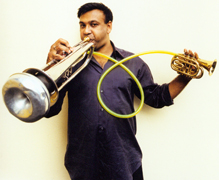 Orka has a quite remarkable feeling of whole-ness. Listening to it is not unlike listening to a composed suite consisting of multiple movements that each share various ideas and motifs, consciously structured so as to create a sense of compositional unity throughout the entire work. The 12 tracks are, for the most part, short bagatelle-esque
movements each functioning as a portrait illustrating a certain characteristic of Mehta's playing. Amidst these, there are 3 or so slightly longer pieces that carry more of a sense of narrative.
One of these longer pieces is the title track, "Orka", which also seems to function as the central kernel of the album. Both before and after the title track one hears various references and variations on the melodic and rhythmic themes that it contains. "Orka" itself sounds not unlike a short raga (and indeed, ignoring the obvious technical lineage from musicians such as Wadada Leo Smith and Bill Dixon, it is Indian music that has the most audible and profound influence on the musical content of Mehta's style), with its distinctive rhythmic and melodic patterns repeated and changed at various tempi, volumes, and degrees of syncopation.
The coming together of the rhythmic and melodic influence of Indian music and the textural and timbral expansion of the trumpet's sound world from trumpet pioneers such as Wadada Leo Smith and Bill Dixon has enabled Rajesh Mehta to create a very three-dimensional sense of melody. His obvious control over not just pitch and rhythm but also significant and sudden changes in timbre and tone quality through the use of his hybrid-trumpet technique and selection of mutes lends an immediate sense of colour and space to the melodic lines.
Another point of interest is the communication between Lovens and Mehta on the duo tracks (9 of the 12). Their playing is very gestural, and the almost spontaneous decisions made between the two create rhythmic movements that would not sound out of place in the music of Luigi Nono or Helmut Lachenmann.
I also wonder if the watery farting sounds and muted yelps on the track "Vindaloo" are programmatic.
-----------------
Point of interest, youtube video of Rajesh Mehta with Paul Lovens and Rohan de Saram. Mehta's playing is much more abstract in this video than on Orka. His distinctive musical voice is still very apparent, though.
